
Glossary
Words from the auction and this site: terms like collectible, board, hint, snipe and Bonus, and slang like Pendragon run, all-in and low-cost farming.
Game terms
The in-game words you meet in a match, its rounds and its settlement.
- Hall
- The three auction venues: Shell, Coral and Pearl. Entry fees 0 · 5,000 · 20,000.
- Storehouse (board)
- The grid holding the collectibles up for auction. 10 slots wide, extending downward.
- Collectible
- A single object in the storehouse. The site catalogs all 220 in the Collectibles Index.
- Items (lot)
- The collectibles up for auction in a match. "Item count" is how many there are.
- Slots
- The number of grid cells a collectible takes up, from 1 slot to 25 slots (5×5).
- Rarity
- A collectible's tier. From lowest: White (grey in the data), Green, Blue, Purple, Gold, Red.
- Silhouette
- Only a collectible's position and size are revealed. Its identity and color are unknown.
- Color reveal
- Only a collectible's rarity color is revealed.
- Identity reveal
- Exactly which collectible it is has been revealed.
- Hint
- The 8 averages and totals the game shows. What you enter into the Combo Finder.
- Average
- The average price of the collectibles in a group. The game shows it as an integer with the decimals dropped.
- Total
- The sum of the prices of the collectibles in a group.
- Rounding down
- Cutting off everything after the decimal point. Not rounding to the nearest.
- Joint search
- The search used when a slot hint and a color hint are entered together: both constraints share the quantity of the collectibles that belong to both groups.
- Round
- A match lasts up to 6 rounds. Rounds 1–4 use multipliers, round 5 goes to the highest bid, and round 6 is only for the players tied in round 5.
- Multiplier (threshold)
- What the top rival bid is multiplied by; you must beat the result to win this round. 2 · 1.6 · 1.3 · 1.1.
- Bid
- The amount you put in each round. A whole number, 1 or more.
- Win the lot
- The unique highest bid that meets the condition takes the storehouse.
- No sale
- The match ends with nobody taking the storehouse: another tie in round 6, or everyone folds.
- Fold
- Bidding 0. You are out of that match.
- Out
- After folding, you can't take part in the remaining rounds.
- Snipe
- Winning by bidding just over the top rival bid × the multiplier.
- Bonus
- Money the other players receive when the winner takes a loss: 10% of the loss, or 30% under Bonus Bonanza. The game labels it "Bonus Rewards".
- Entry fee
- What you pay to enter a hall. Not refunded, even on a no sale.
- Earnings
- For the winner: Actual Value − Final Sale Price − entry fee − Device costs used. For everyone else: Bonus − entry fee − Device costs used.
- Actual Value (board value)
- The total price of the collectibles in the storehouse, with any doubling condition applied.
- Device Set
- The bundle of items you take into a match, one set per match. There are 17.
- Device item
- A single item in a set. Each can be used once, one per round.
- Auctioneer Public Intel
- Information shown to everyone in rounds 1 and 3, drawn at random from 14 kinds.
- Court condition
- A rule change applied to each match: Blackout, Insider Intel, Double Up!, Super Rush, Gemheart, Bonus Bonanza or By the Book.
- Blackout
- The condition where bid amounts are hidden and only the rankings are shown.
- Board effect
- The chest effect applied before a match starts. A particular type, or expensive collectibles, appear a little more often.
- Jackpot
- A board with a huge value. The site's stats count boards worth 5,000,000+ (Pearl), 3,000,000+ (Coral) and 500,000+ (Shell) separately as jackpot boards.
Community slang
Community shorthand for collectibles and play styles.
- Eternal Heart (영마)
- Eternal Heart. 1×1 Red, 1,314,520.
- Pendragon (팬드)
- Pendragon Model. 5×5 Red, 20,171,210.
- Pendragon run (팬드런)
- A strategy of re-queuing and playing on only when a board could hold the Pendragon Model. Step one is checking for a 5×5 silhouette.
- Eternal Heart run (영마런)
- A strategy that targets boards holding the Eternal Heart, checked with the 1-slot average.
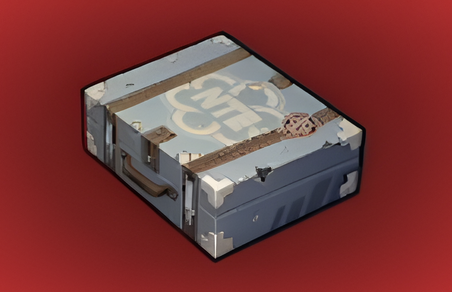
- Suitcase (상자)
- Antique Suitcase. 3×2 Red, 577,777.
- Scepter (셉터)
- Radiant Scepter. 5×1 Red, 288,888.
- Koi (잉어)
- Golden Koi Statue. 4×4 Red, 22,668,888.
- Giovanni (조반니)
- Giovanni's Gilded Statue. 4×5 Gold, 271,827.
- Pizza (피자)
- Flatbread. 4×5 Gold, 202,798.
- All-in (쇼부)
- Settling the match early with one big bid.
- Sniper (저격형)
- A style that works the multiplier backwards to win by bidding just above a rival.
- Low-cost farming (쌀먹)
- Spending as little as possible, folding early and taking small, steady profits.
- No-tool (노템)
- Playing without using any Device items.
- Re-queue (리매칭)
- Dropping a match and queuing again for a new board.
- Gacha (가챠)
- A luck-based pull: hoping a Collectible device happens to reveal a high-value collectible.
- Bankroll (시드)
- The money you bring to spend at auctions.
- Search run (탐색런)
- A strategy of re-queuing until a board shows a specific collectible (Suitcase, Scepter).






Site terms
The names of Going, Going, Gone! Archive's screens and features.
- Combo Finder
- The home screen, which finds candidate collectible combos from hints.
- Snipe Calculator
- The screen that works out snipe thresholds from the round multipliers.
- Records
- Odds and stats built from the results players register.
- Log a Match
- The screen where you log a match's winning character, hall, winning round and result.
- Contribution tiers
- Tiers based on your combined Records and Log a Match entries: Red at 100 · Diamond at 500 · Emerald at 1,000 · Pendragon at 1,500.
- Auction Practice
- Practice against 3 bots on boards generated from odds tables calibrated to real records. Practice mode, Challenge mode (Survival), Private mode and Board Reading.
- Survival mode
- A challenge that starts at 7,000,000: a run ends at 5,000,000 or below and is cleared once you pass 80,000,000.
- Playbook
- Strategy articles checked and published by the operator, each drawn as a 1R–5R round map.
- Write your own
- How players write and send in a strategy. Once the operator reviews and approves it, it joins the Playbook.
For the rules from the start, see the Basics Guide; for common questions, the FAQ.