
Reading opponents — trusting bids by character · spotting bait · pressure bids
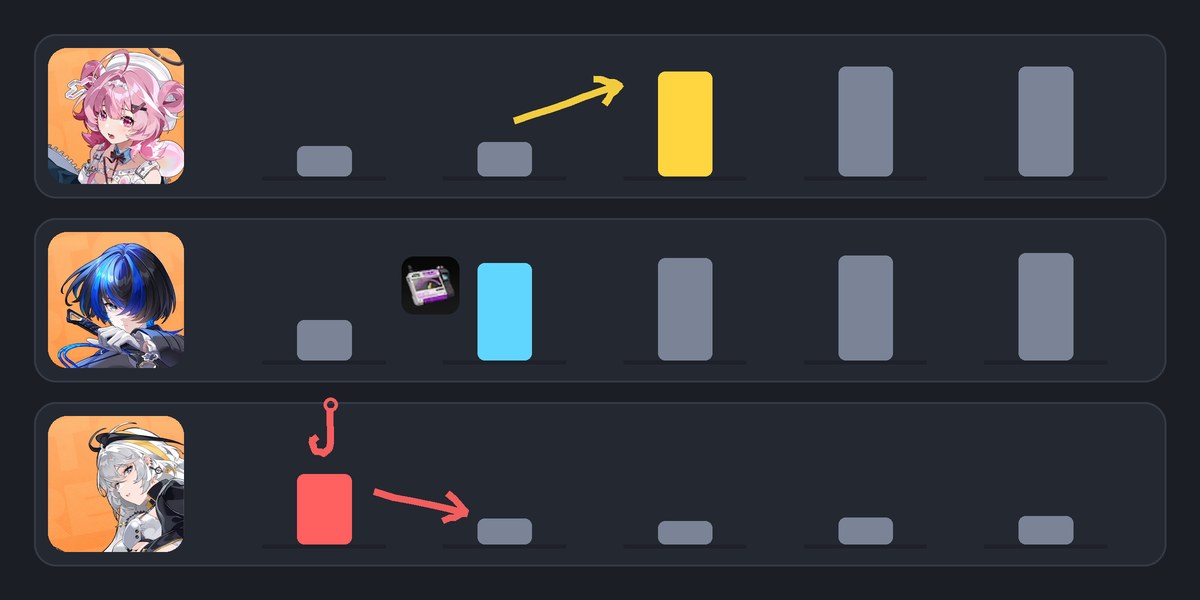
How to use a rival's character and the Devices and bids they used each round in Going, Going, Gone! to decide whether to trust their bid, whether it's bait, and whether to make a pressure bid. Annotated screens show the round each character gets information and the moments when bids suddenly change.
Less the amount than what they saw that round — a lone high bid with no ability or Device behind it is hope or bait
What a rival's card shows
Who bid (character) · how much (amount) · on what basis (Device) — all public in the rival's card
- Player cards — under the nickname: the character name · this round's amount · the Device used this round ("No item used" if none)
- Round log — each player's amount and Device for every past round. Read the change in amount together with what they saw that round
- Everyone sees the Auctioneer Public Intel — if everyone moved the same way in the round right after an Auctioneer line, it's because of public information, not anyone's secret
- If only one player moved a lot, they saw something only they saw — that character's ability round or a Device
- A rival who has finished bidding gets a bid marker (gavel) above their portrait — amounts only show when the round ends, but who bid first and who thought for a long time shows during the round
- Every figure in this article is laid out this way — the left cards show who, the middle table shows when and how much it changed, and what they used
The round each character gets information
A sudden change in bid = the round that character gets information
- Character abilities are public rules — the rival's character alone tells you what that player can know right now
- Rivals you'll meet often in 1.4 —
 Chiz 25% ·
 Hotori 16% ·
 Blackbird 23% ·
 Haniel 14%
| R1 | R2 | R3 | R4 | R5 | |
|---|---|---|---|---|---|
| Haniel | |||||
| Chiz | |||||
| Hotori | |||||
 Daffodill | |||||
 Jiuyuan | |||||
 Adler | |||||
 Edgar | |||||
 Hathor | |||||
| Blackbird1.4 | |||||
 Elyms1.5Top bid last round | |||||
| Not the top bid last round |
| Rival | When information arrives | What they learn | Jump you can trust |
|---|---|---|---|
| Haniel | Start · every round from R2 | 5 silhouettes + rarities at the start → 2 rarities each round | From R1 |
| Chiz | Start · R3 | 8 silhouettes → the identities of those 8 in R3 | R3 |
| Daffodill | Start | Total count of Purple · Gold · Red | R1 (when the count is high) |
| Hotori | R1–R3 · R5 | The silhouettes of one type each round (type included) → in R5, every silhouette of collectibles whose rarity is known | The round that type opens · R5 |
| Blackbird | R1 · R3 · R5 | One of the six Fate's Prophecies | R3 · R5 |
| Jiuyuan | Start · every round | Silhouette of 1 top-rarity piece → rarity + silhouette of 1 each round | Little by little |
| Edgar | Start | Rarity + silhouette of every White · Green · Blue | R1 (the cells left once the cheap ones are ruled out) |
| Adler | R1–R4 | Every silhouette: White → Green → Blue → Purple | R4 |
| Hathor | R5 | The rarity of every collectible | R5 |
- Rivals who can change suddenly — Chiz in round 3 · Blackbird in rounds 3 and 5 · Hathor in round 5 · Hotori in round 5. If the bid moves a lot in these rounds, they saw something new
- Rivals who know from the start — Haniel · Chiz (silhouettes) · Daffodill (counts) · Edgar (the cheap pieces) — their round-1 bids have a basis too
- Rivals who can't see for themselves until the end — Adler can't see Gold or Red with the ability, and Hathor has nothing until round 4. Early high bids from these two are guesses
Rounds where a Device was used


A jump or drop after an identity Device is real — after a shape- or color-only Device, only half so
| Device the rival used | What they saw | Weight of that round's change in bid |
|---|---|---|
| Collectible (Mini–Mega) · Top Collectible | The identities of a few random pieces | Heaviest — up means they saw something valuable, down means something cheap |
| Average price · Total · Count · Slots | Numbers | An amount with calculation mixed in — close to the value |
| Rarity (Mini–Mega) · Type rarity | The colors of a few pieces | They may have seen a Red — but not its size |
| Size (Mini–Mega) | The silhouettes of a few pieces | They saw a big shape — not its identity |
| No item used | Ability · Auctioneer only | Weigh it by the information that character gets that round |
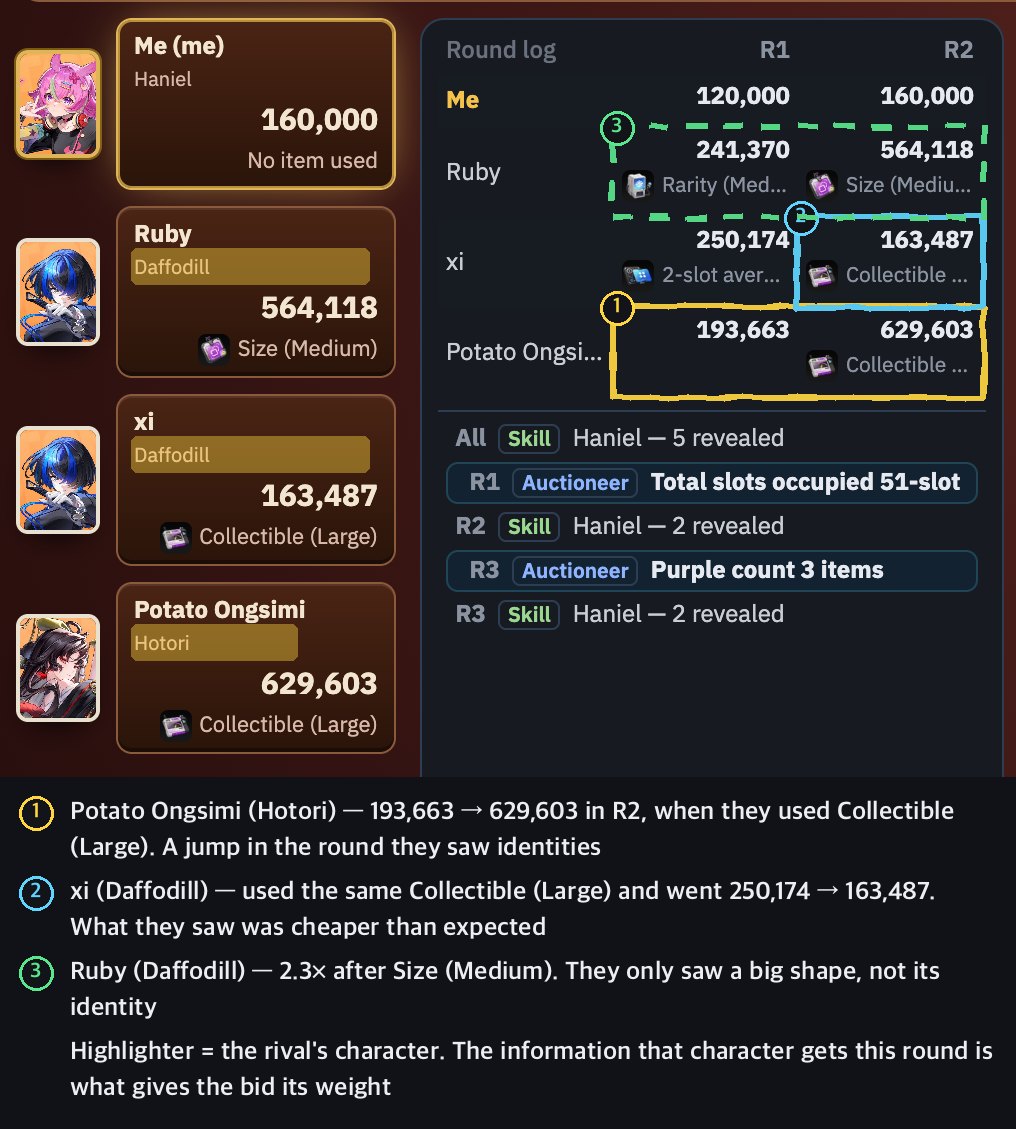
- First figure ① and ② — both used the same Collectible (Large), but one more than tripled and the other went down. Collectible (Large) shows 5 random pieces, so the two saw different things — both moved according to what they saw
- ③ doubled after Size (Medium) — they only saw a big silhouette, not its identity. Watch whether they use an identity Device next round
- If the bid stays the same after an identity Device, it overlapped with pieces they already knew, or what they saw matched their guess
When the bid jumps without a Device
A jump with no item used is real only in that character's ability round
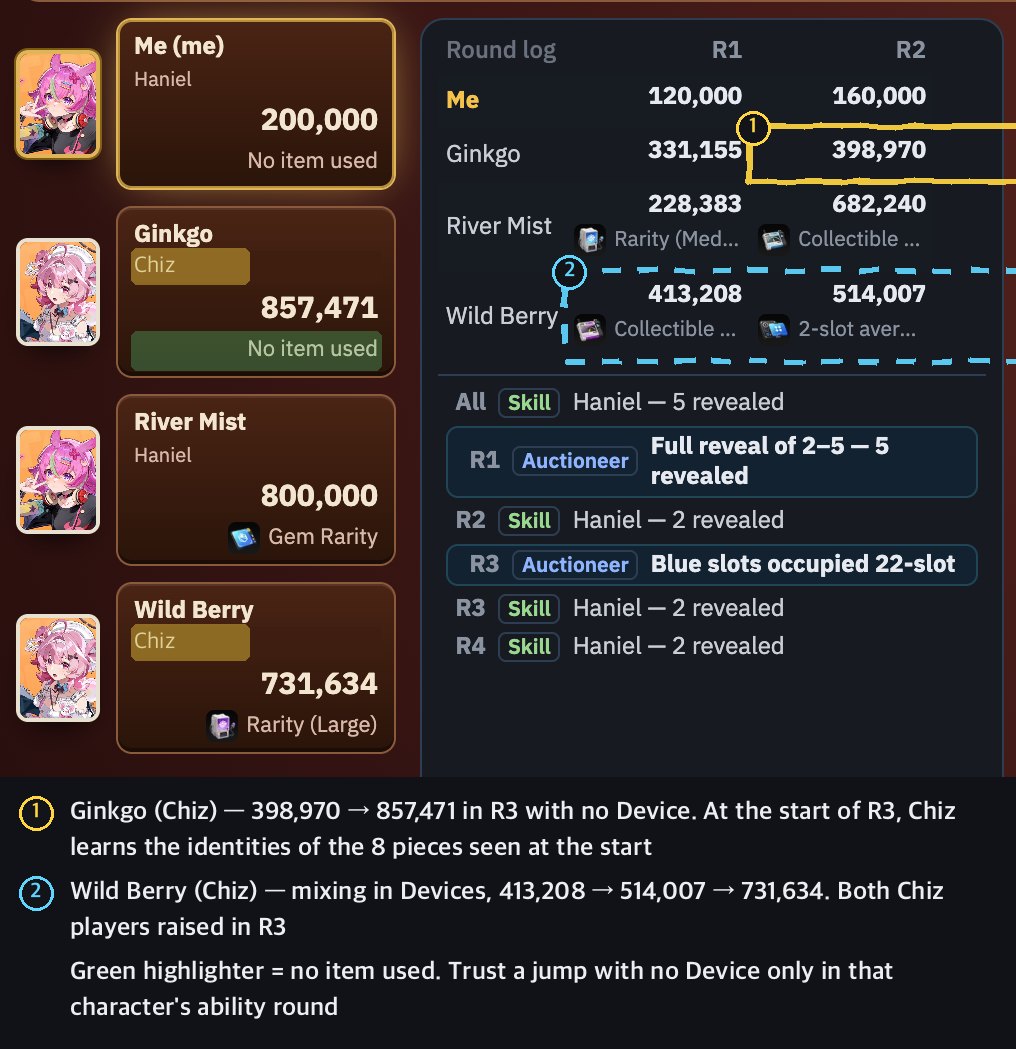
- Chiz in round 3 — the identities of the 8 pieces whose silhouettes were seen at the start are revealed. If the bid more than doubles without a Device, something valuable is among those 8. Conversely, if it drops in round 3, all 8 were cheap
- Chiz's round-1 and round-2 bids are silhouette guesses — don't follow a high bid in rounds 1–2; wait for round 3
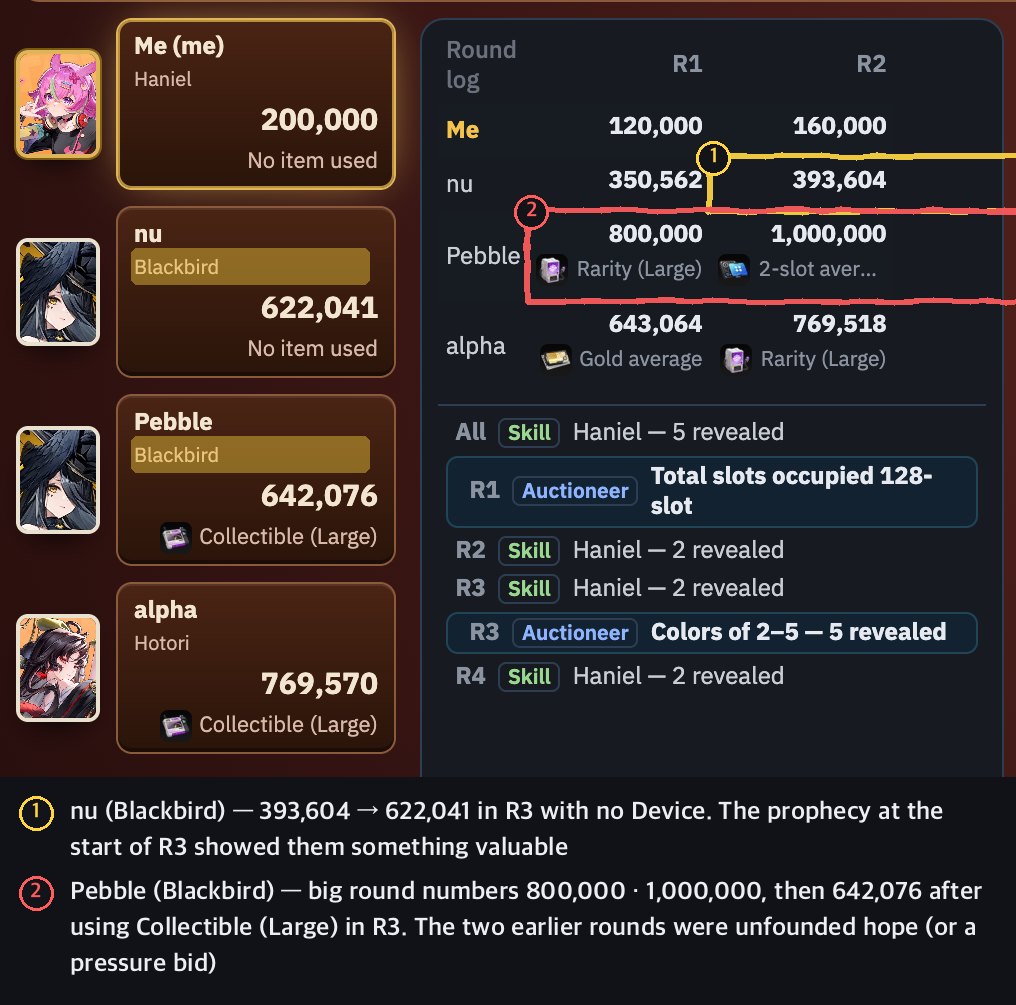
- Blackbird in rounds 3 and 5 — one of the six prophecies arrives. With ③ (3 collectibles) or ⑥ (top-rarity value) they know the value exactly; with ① (collectible count) it hardly changes. If the bid rises a lot without a Device, assume they got ③ or ⑥
- Blackbird's round-1 high bid rests on just one prophecy — see whether it holds in round 3
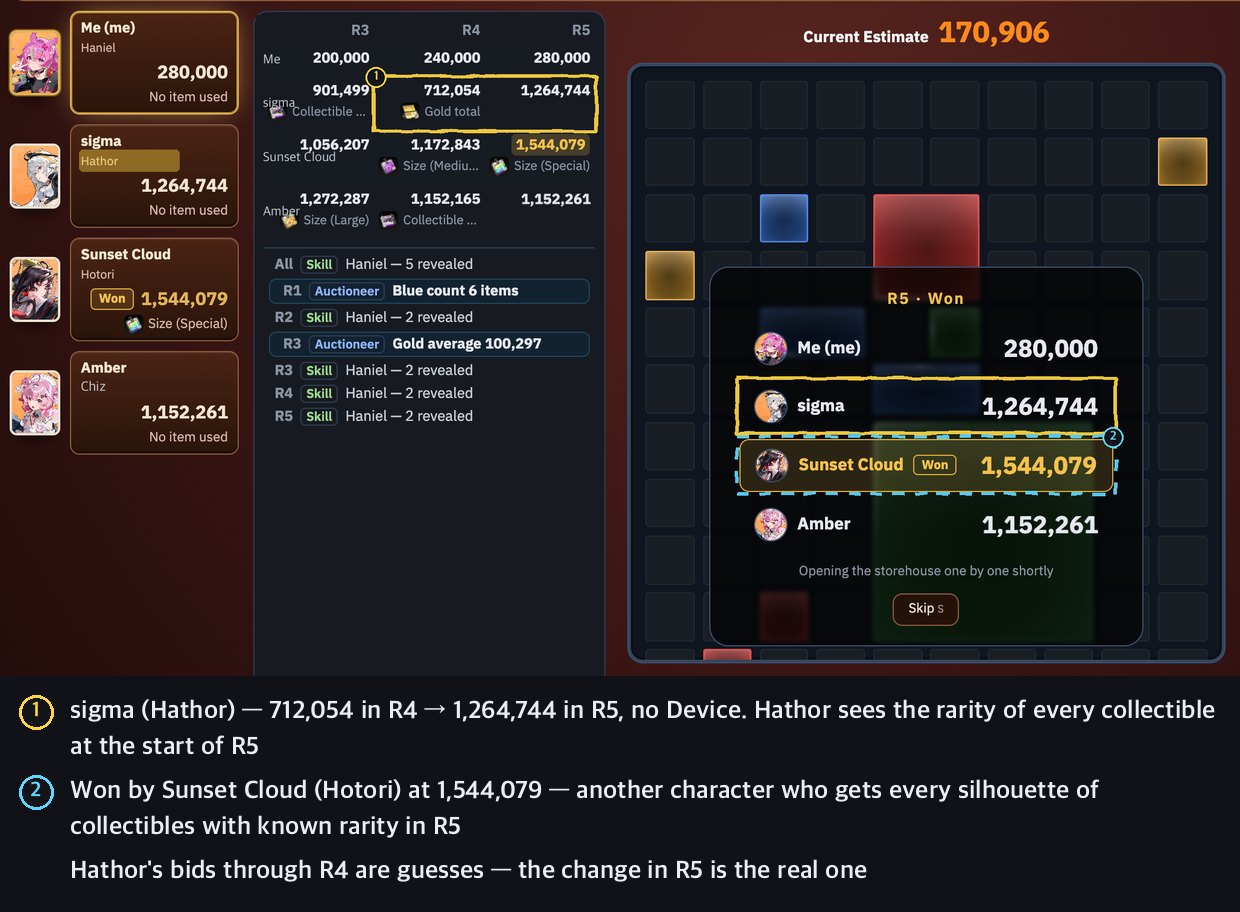
- Hathor in round 5 — rounds 1–4 have nothing, so those bids are guesses. If the bid rises a lot after seeing every rarity in round 5, the board has many Red pieces
- Round 5 is highest-bid-wins — Hathor's round-5 bid is a real value that can become the winning price as is
- Hotori in round 5 — the silhouettes of every collectible whose rarity is known so far open at once (including rarities the Auctioneer revealed). A big jump in round 5 means they saw a big Red shape
Telling bait apart
A high bid in a round with no basis + a pullback the next round = hope or bait
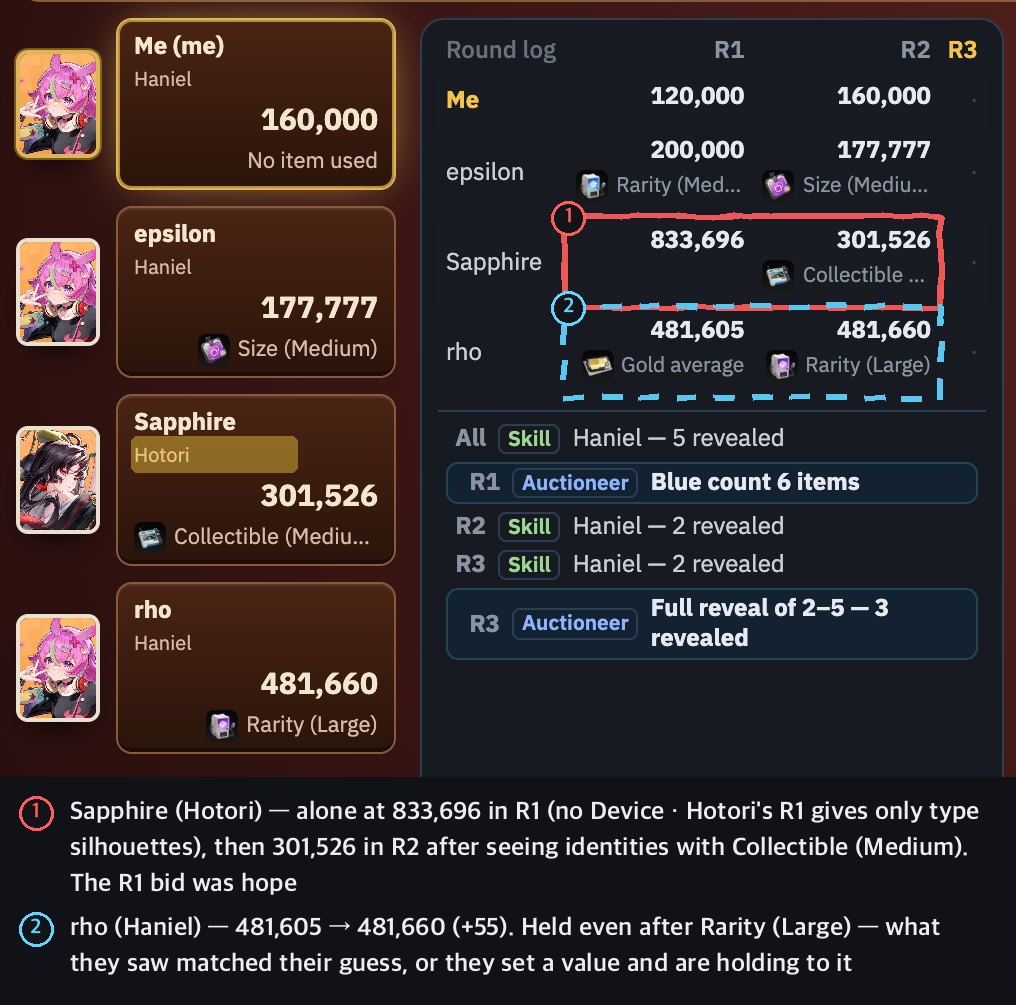
- ① Did they see anything new that round? — no ability round and no Device, yet alone at the top: be suspicious
- ② Big round numbers — calculated amounts have scattered last digits. Numbers like 800,000 · 1,000,000 are often a preset cap or a probing value
- ③ If they see identities the next round and go down, the earlier bid was hope (first figure ②, figure above ①)
- ④ If the player who was alone at the top in round 1 holds in round 2, they had a basis — then follow
- ⑤ A bid that holds with a tiny change (+55) means what they newly saw matched their guess — that player's value is nearly settled
- The price of taking the bait — if you trust an unfounded high bid and follow it up, the moment the rival drops out only your bid is left
Pressure bids — raising others' price with a price you won't buy at

Pressure bid = raising the price to collect the Bonus when someone else wins at a loss — the cost is the risk of getting stuck with it
- Bonus — when the winner takes a loss, the others each get 10% of that loss (30% under Bonus Bonanza)
 In-game
- When a pressure bid pays — when a rival is already bidding above what you think the board is worth. If they buy even higher, their loss grows and so does your Bonus
- Never go past the line where your bid would win that round — if everyone else drops out, your bid is the winning price (round thresholds in Part 4)
- A pressure bid in round 5 is the same as buying — round 5 is highest-bid-wins, so your pressure bid becomes the winning price as is. Pressure bids only through round 4
- Pressure bids barely work on rivals who know the board value (Chiz after round 3, Haniel) — they know the value and won't follow above it
- Rivals who bid on guesses (Hathor and Adler through round 4) may follow, or suddenly drop out — if they drop out, you're stuck with it
- Probing is a kind of pressure bid too — a price to see how others react (800K on the Eternal Heart in Coral and the like, Blackbird advanced). If a rival follows, they know the same thing
 Eternal Heart1,314,520
Blackout — reading without amounts
Even with amounts hidden, ranks and Devices used are public — a fold shows as last place and an instant bid the next round
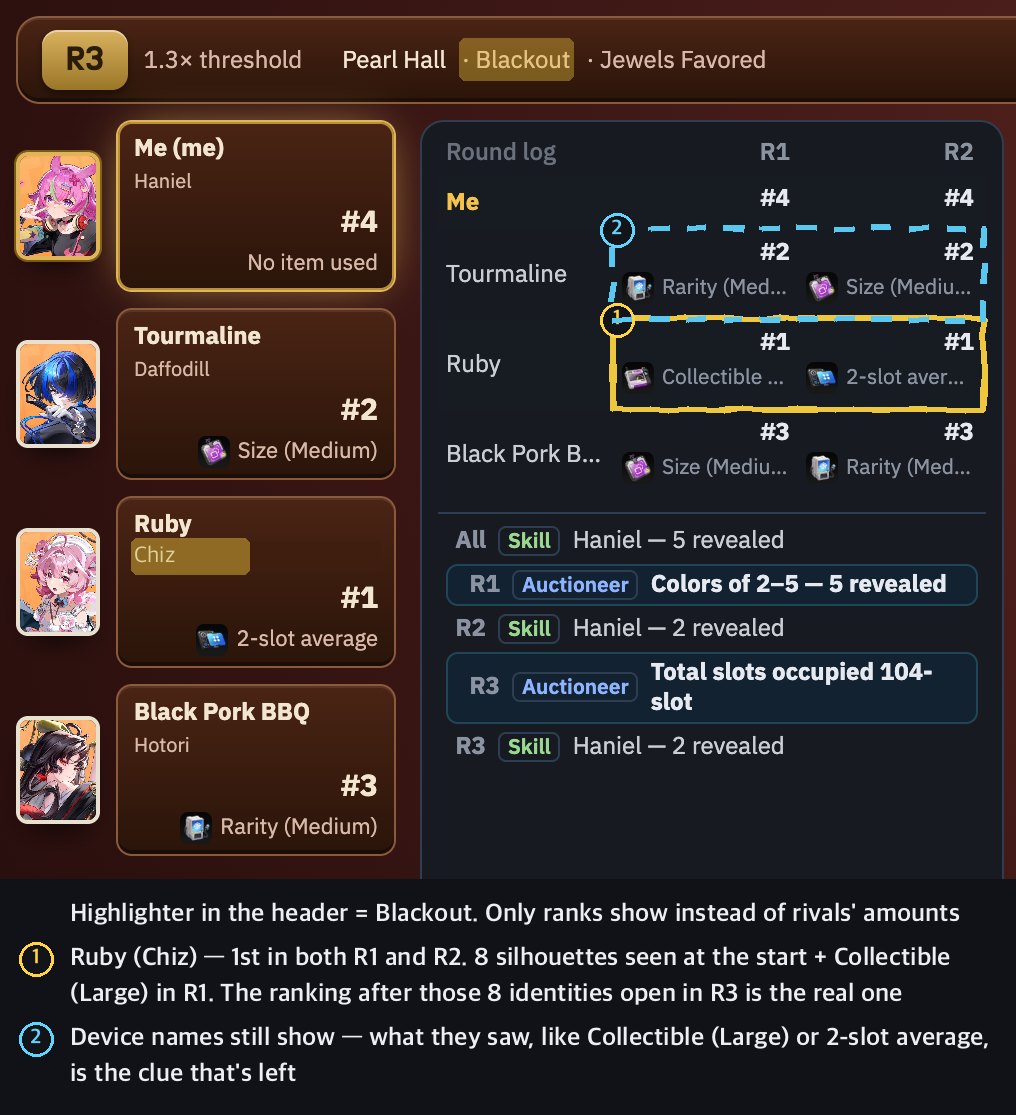
- If the same player is 1st every round, they value the board highest — weigh it by what that character can know
- A round where the ranking changed = a round where someone saw something new — match it against that player's ability round and Device
- With amounts hidden, pressure bids and bait don't work — bid on your own information only
- Folds aren't marked separately — a player who folded just shows as last place (4th in a 4-player match)
- Instead, the player whose bid marker appears the moment the next round starts is the one who folded — they're already out with nothing to think about, so there's no delay
- So in a Blackout, watch who bid when along with the ranking — if last place bid instantly, they folded; if they took their time, they're still in
Each rival at a glance
The rival's character alone sets which rounds to trust and which to doubt
| Rival | Round to trust | Bids to doubt | When it changes suddenly |
|---|---|---|---|
| Haniel | From R1 | — | A little every round |
| Chiz | R3 | High bids in R1–R2 | R3 |
| Daffodill | R1 (count) | A jump in R2 with no Device | — |
| Hotori | The round that type opens | Jumps unrelated to the type | R5 |
| Blackbird | R3 · R5 | High bid in R1 | R3 · R5 |
| Jiuyuan | A little each round | High bid in R1 | — |
| Edgar | R1 | — | — |
| Adler | R4 | High bids in R1–R3 | R4 |
| Hathor | R5 | All of R1–R4 | R5 |
- The table is a starting point — in a round where a Device was used, reweigh by that Device regardless of character
See also
Round multipliers and snipe thresholdsThe 9 charactersBlackbird — reading the board and betting with Fate's ProphecyHotori — reading value from type silhouettes